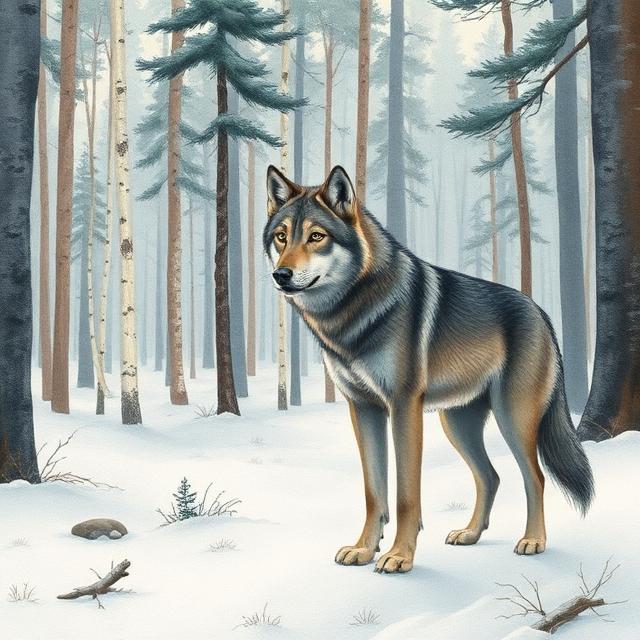
Arctic Fox in Scandinavia

The Arctic fox (Vulpes lagopus), known as fjällräv in Swedish, is one of Scandinavia's most endangered mammals. Perfectly adapted to survive in extreme cold, this small and resilient predator once roamed the mountain tundra across the entire Scandinavian mountain range. Today, the Scandinavian population is critically small, making the Arctic fox a symbol of both the fragility and the resilience of Nordic wilderness.
Physical Description
The Arctic fox is a small, compact canine, well adapted to life in extreme cold. Adults weigh between 2.5 and 5 kilograms, making them considerably smaller than the red fox. They measure about 50 to 65 centimetres in body length, with a thick, bushy tail of 25 to 30 centimetres that serves as a warm blanket when the fox curls up to sleep. One of the Arctic fox's most remarkable features is its seasonal coat change. In winter, the most common colour morph has a dense, pure white coat that provides excellent camouflage against the snow. In summer, the fur transforms to a thinner brownish-grey coat. A rarer 'blue' morph remains dark grey-brown year-round. Their short, rounded ears, compact muzzle and heavily furred paws minimise heat loss in sub-zero temperatures.
Habitat
Arctic foxes in Scandinavia inhabit the alpine tundra zone above the treeline, typically at elevations between 800 and 1,200 metres. They are found along the Scandinavian mountain range from northern Norway and Sweden down to the mountains of central Scandinavia. They prefer open, treeless landscapes with rocky terrain that provides denning sites. Arctic fox dens are often used for generations and can have dozens of entrances. The foxes depend on mountain ecosystems where lemmings and other small rodents are available as their primary food source.
Population and Conservation
The Arctic fox is one of the most threatened mammals in Scandinavia. The total Scandinavian population — across Sweden, Norway and Finland — is estimated at only 300 to 450 adults. In Sweden alone, there are roughly 100 to 150 individuals. The species was hunted heavily for its fur in the 19th and early 20th centuries, which devastated the population. Although it has been legally protected since 1928 in Sweden and 1930 in Norway, the population has failed to recover fully. Key threats today include competition with the red fox, which has expanded its range northward due to climate change, as well as fluctuations in lemming populations and habitat changes. Breeding programmes and supplementary feeding stations have been established in Sweden and Norway to support the population. These conservation efforts have shown promising results in some areas.
Diet
The Arctic fox's diet is closely tied to the availability of small rodents, particularly lemmings. In years when lemming populations peak, Arctic foxes can produce large litters of up to 14 pups. When lemming numbers crash, reproduction may fail entirely. Beyond lemmings, Arctic foxes eat voles, mountain hares, birds and bird eggs, insects and berries. They are also opportunistic scavengers, feeding on carcasses left by larger predators. In coastal areas of northern Norway, some Arctic foxes supplement their diet with fish and marine invertebrates. Like wolverines, they cache surplus food for times of scarcity.
Behaviour
Arctic foxes are generally monogamous and often mate for life. Pairs establish dens in spring, and pups are born in May or June after a gestation period of about 52 days. Litter sizes vary dramatically depending on food availability — from as few as 2 pups in lean years to 14 or more when lemmings are abundant. Both parents care for the young, and occasionally non-breeding adults from previous litters help raise the new pups. Arctic foxes are active year-round and do not hibernate. During winter, they may travel vast distances across the mountains in search of food. Individual foxes have been tracked covering over 1,000 kilometres in a single season. Despite harsh conditions, Arctic foxes are remarkably adaptable. Their thick winter coat allows them to withstand temperatures as low as minus 50 degrees Celsius without increasing their metabolic rate.
Interesting Facts
- The Arctic fox can survive temperatures as low as minus 70 degrees Celsius, making it one of the most cold-tolerant mammals on earth.
- Arctic fox dens can be centuries old, passed down through generations and expanded over time to include up to 100 entrances.
- In 2022, a tracked Arctic fox travelled over 3,500 kilometres from Norway to Canada in just 76 days, crossing sea ice.
- The Arctic fox has the warmest fur of any mammal, even warmer than polar bear fur relative to body size.
- Sweden and Norway run active conservation programmes including supplementary feeding and captive breeding to save the Scandinavian population.
Explore the Habitat
Learn more about the ecosystems this species calls home.