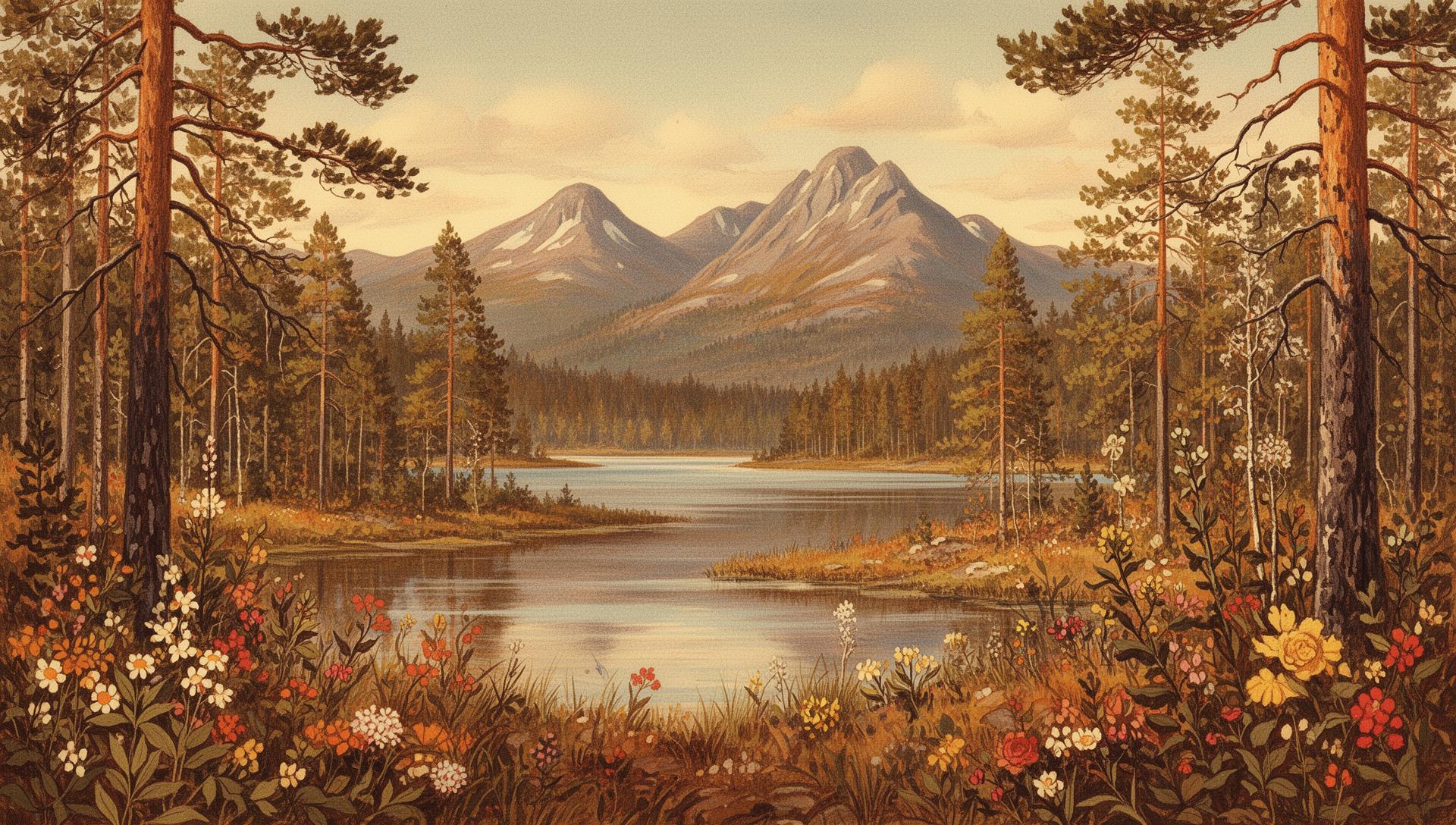
Nordic Nature
The natural landscapes of Scandinavia and the broader Nordic region are among the most varied and unspoiled in Europe. From ancient forests that stretch for hundreds of kilometres to treeless mountain plateaus and Arctic tundra, these environments support a rich diversity of plant and animal life. Understanding these ecosystems is essential to appreciating the wildlife that calls them home.
Boreal Forest — The Scandinavian Taiga
The boreal forest, or taiga, is the dominant landscape of Scandinavia. It extends across vast areas of Sweden, Norway and Finland, forming one of the largest forested regions on Earth. Dominated by coniferous trees — primarily Norway spruce and Scots pine — the taiga also contains birch, aspen and rowan, particularly in areas that have been disturbed by fire or logging.
The boreal forest is home to moose, brown bears, lynx, wolverines, capercaillie and a wide variety of smaller mammals and birds. The forest floor is often covered with mosses, lichens and berry-producing shrubs such as blueberry and lingonberry, which provide important food sources for both wildlife and people.
Scandinavian Mountains
The Scandinavian mountain range, known as Fjällen in Swedish and Fjellet in Norwegian, runs along the border between Norway and Sweden for over 1,700 kilometres. These mountains are ancient, worn down over hundreds of millions of years, and are characterised by rounded summits, deep valleys and vast open plateaus above the treeline.
Above the treeline, the landscape transitions to alpine heath, with dwarf shrubs, mosses and lichens. This is the territory of wild reindeer, Arctic foxes, lemmings and mountain hares. Golden eagles and gyrfalcons patrol the skies. In summer, the mountain meadows burst with wildflowers, while in winter they are covered by deep snow and battered by harsh winds.
Northern Tundra
In the far north of Scandinavia — particularly in northern Norway and Finland — the landscape gives way to Arctic tundra. Here, the growing season is extremely short, and the ground may remain frozen as permafrost just below the surface. Trees cannot survive in these conditions, and the vegetation consists of low shrubs, grasses, mosses and lichens.
The tundra is an important habitat for reindeer, snowy owls, Arctic foxes and a variety of migratory bird species that travel thousands of kilometres to breed during the brief northern summer. Despite its harsh appearance, the tundra ecosystem is fragile and highly sensitive to climate change.
Nordic Lakes and Wetlands
Scandinavia contains some of the largest and most pristine freshwater environments in Europe. Sweden alone has nearly 100,000 lakes, while Finland is often called the 'land of a thousand lakes' — though the actual number exceeds 180,000. These lakes, along with extensive wetlands, bogs and river systems, are vital habitats for fish, amphibians, waterfowl and aquatic plants.
Wetlands and peatlands play a critical role in carbon storage and water regulation. They support species such as whooper swans, cranes, otters and beavers. Many of these environments are protected as nature reserves, but they face growing pressure from drainage, forestry and climate change.