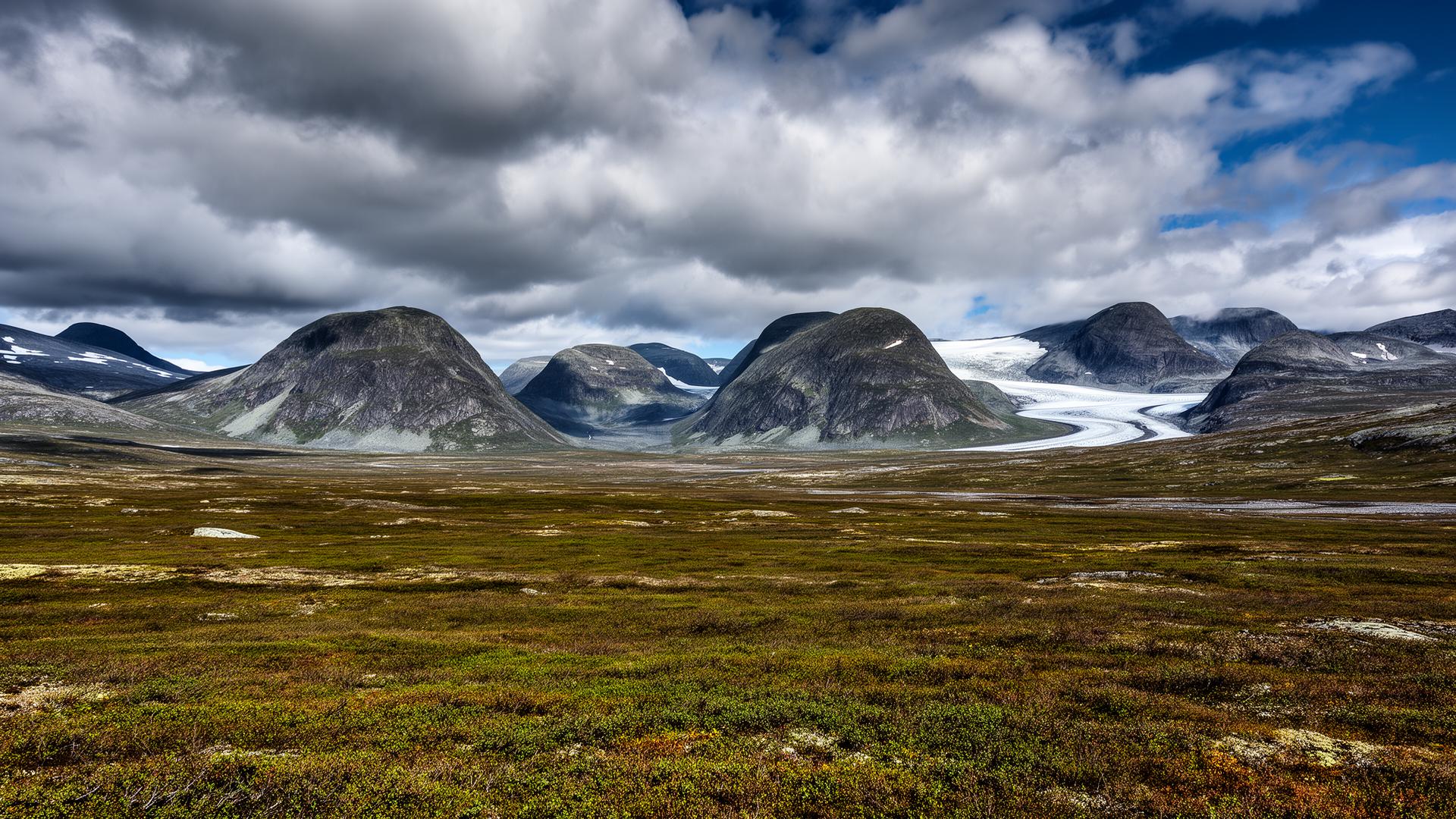
The Scandinavian Mountains — Fjällen
The Scandinavian mountain range, known as Fjällen in Swedish and Fjellet in Norwegian, stretches for over 1,700 kilometres along the border between Norway and Sweden. These are among the oldest mountains in the world, shaped by hundreds of millions of years of erosion and sculpted by successive ice ages into the rounded, windswept plateaus and deep valleys that define the landscape today.
Geology and Formation
The Scandinavian mountains were formed during the Caledonian orogeny, approximately 400 to 500 million years ago, when the ancient continents of Baltica and Laurentia collided. The resulting mountain range was once comparable in height to the modern Himalayas, but hundreds of millions of years of erosion have worn them down to their present modest elevations.
The highest peak, Galdhøpiggen in Norway, reaches 2,469 metres — a fraction of its original height. In Sweden, the highest point is Kebnekaise at 2,097 metres. Most of the mountain range consists of broad, rounded summits and vast plateaus, or fjällvidder, that stretch above the treeline in a seemingly endless expanse of open terrain.
The most recent ice age, which ended roughly 10,000 years ago, left a profound mark on the landscape. Glaciers carved deep U-shaped valleys, deposited moraines and created the thousands of mountain lakes, or fjälltjärnar, that dot the alpine zone. Small remnant glaciers still exist in the highest areas of northern Sweden and Norway, though they are retreating rapidly due to climate change.
Vegetation Zones
The Scandinavian mountains exhibit a clear altitudinal zonation of vegetation. The transition from forest to open mountain is one of the most striking features of the landscape.
The subalpine zone, immediately below the treeline, is dominated by mountain birch (Betula pubescens subsp. tortuosa). These hardy, often gnarled trees form the last outpost of forest before the open mountain. The treeline varies with latitude — from around 1,000 metres in central Scandinavia to as low as 500 metres in the far north.
Above the treeline, the low alpine zone is characterised by dwarf shrubs — blueberry, crowberry and dwarf birch — interspersed with grasses and sedges. Higher still, in the middle alpine zone, vegetation becomes sparse: mosses, lichens and hardy cushion plants cling to the rocky ground. The high alpine zone, above approximately 1,500 to 1,800 metres, supports only scattered lichens and is largely barren rock and permanent snow.
Wildlife of the Mountains
Despite their harsh conditions, the Scandinavian mountains support a distinctive community of wildlife. The Arctic fox, one of Scandinavia's most endangered mammals, inhabits the alpine tundra above the treeline, where it depends on cyclical lemming populations for food. The wolverine, a powerful and elusive mustelid, roams the mountain ranges and upper boreal forests, covering vast distances in search of prey and carrion.
Reindeer — both wild herds in Norway and semi-domesticated herds managed by Sámi communities — are the most visible large mammals of the mountain landscape. They migrate between summer mountain pastures and winter forest ranges, a pattern that has been maintained for thousands of years.
Birds of the mountain zone include the golden eagle, gyrfalcon, rough-legged buzzard and ptarmigan. The willow ptarmigan and rock ptarmigan are superbly camouflaged, changing their plumage from mottled brown in summer to pure white in winter. The dotterel, a small wading bird, breeds on the highest mountain plateaus and is notable for its reversed sex roles — the male alone incubates the eggs and raises the chicks.
The Norwegian lemming is perhaps the most ecologically important small mammal of the mountains. Their population cycles, which peak every three to four years, drive the breeding success of Arctic foxes, snowy owls, long-tailed skuas and other predators. In peak years, lemmings are visible everywhere on the mountain plateaus, and their burrows and runways crisscross the alpine heath.
Seasons in the Mountains
Winter in the Scandinavian mountains is long and severe. Snow typically covers the ground from October to May, and temperatures can drop below –30°C. Storms and high winds are common, and above the treeline there is little shelter. Yet the winter landscape has a stark, austere beauty — vast white plateaus under pale Arctic light, with only the dark outlines of windswept rocks breaking the horizon.
Spring comes late to the mountains, often not until June. The snowmelt transforms the landscape, feeding streams and rivers and flooding mountain bogs. Alpine wildflowers bloom in a brief, intense burst — mountain avens, glacier buttercups and Alpine gentians appear as soon as the snow retreats. The midnight sun bathes the mountains in continuous light for weeks, accelerating plant growth and providing endless hunting hours for raptors and wading birds.
Autumn arrives early — by September, the first frosts touch the high plateaus and the dwarf birch turns vivid shades of red and orange. This brief, dramatic colour display is one of the great natural spectacles of Scandinavia. By October, the first snow has returned.
The Sámi and the Mountains
The Scandinavian mountains are the ancestral homeland of the Sámi people, the indigenous population of northern Europe. For thousands of years, the Sámi have lived in close relationship with the mountain landscape, and reindeer herding remains a central part of Sámi culture and livelihood.
The seasonal migration of reindeer between coast, forest and mountain — known as the renskötsel cycle — follows ancient routes that cross national borders. This tradition is legally protected in Sweden, Norway and Finland, and Sámi reindeer herding is recognised as an important cultural heritage. The mountains are not just a landscape; they are a living cultural space.
Conservation and Climate Change
Many of Scandinavia's most important national parks are located in the mountain region. Sarek, Padjelanta, Abisko and Stora Sjöfallet in Sweden, and Jotunheimen, Rondane and Dovrefjell in Norway, protect large areas of mountain wilderness. These parks safeguard habitats for threatened species and preserve landscapes of outstanding natural beauty.
Climate change poses a growing threat to the mountain ecosystems. The treeline is moving upward as temperatures rise, shrinking the available alpine habitat. Glaciers are retreating, altering water flows and reducing the unique habitats associated with glacier margins. Species adapted to cold conditions, such as the Arctic fox and ptarmigan, face increasing competition from lowland species that are expanding their ranges northward and upward.
Monitoring and research programmes are tracking these changes, but the pace of warming in the Arctic and sub-Arctic is among the fastest on earth. Protecting the mountain landscape — and the species and cultures that depend on it — is one of the defining conservation challenges of our time.