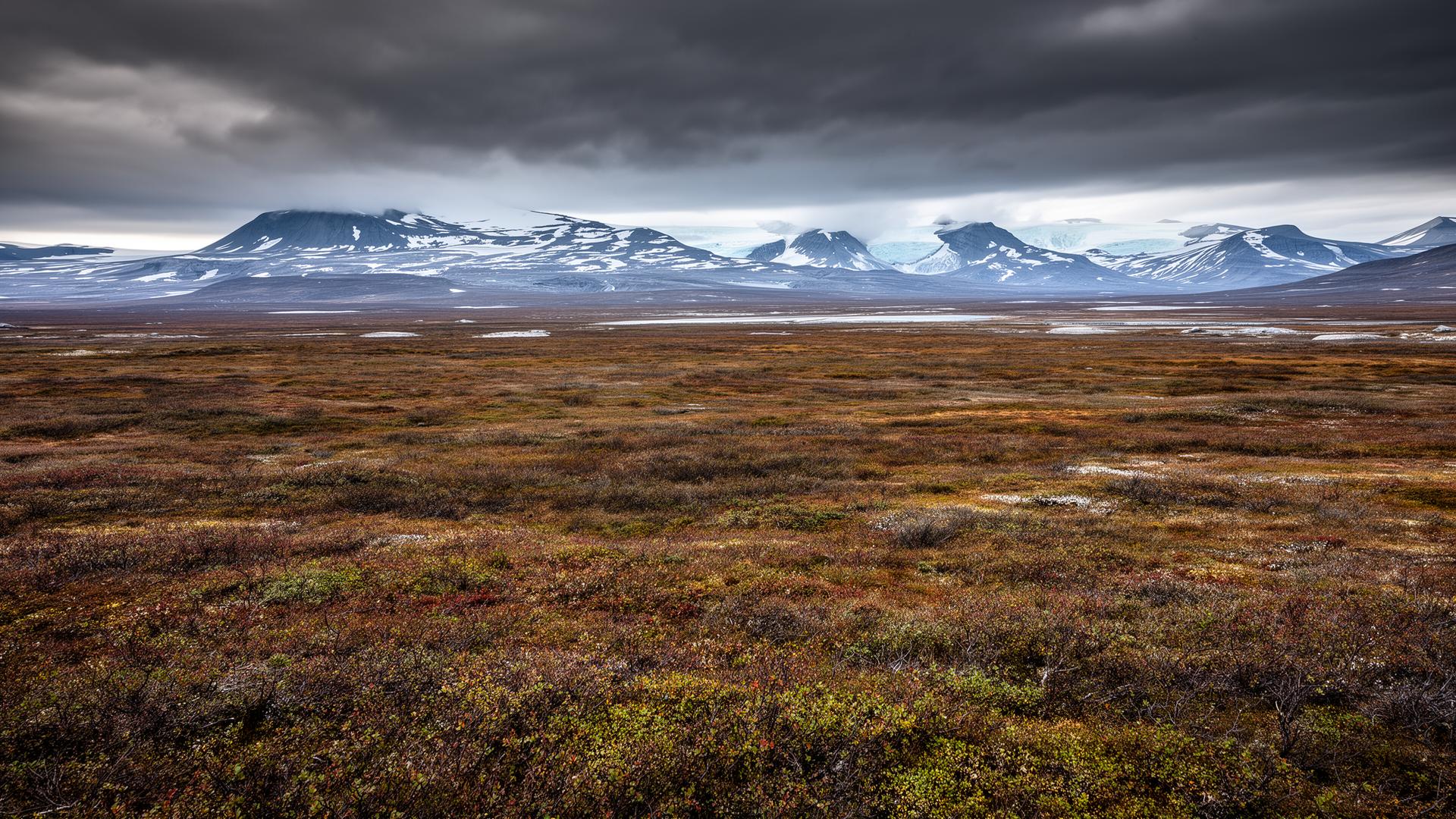
The Arctic Tundra of Scandinavia
Beyond the treeline, in the far north of Norway and Finland, the landscape opens into the Arctic tundra — a vast, treeless expanse where the growing season lasts only weeks and the ground may remain permanently frozen beneath the surface. It is one of the most extreme environments in Europe, yet it supports a surprisingly rich community of life adapted to conditions that would defeat most organisms.
What Defines the Tundra?
The tundra biome is characterised by the absence of trees. Temperatures are too low, the growing season too short and the winds too severe for trees to establish. Instead, the vegetation consists of low-growing shrubs, grasses, sedges, mosses and lichens that hug the ground for protection from the wind and to benefit from the thin layer of soil that thaws during summer.
In Scandinavia, true Arctic tundra is found primarily along the northern coast of Norway — in Finnmark and Troms — and in the northernmost parts of Finnish Lapland. Alpine tundra, which occurs above the treeline on mountains, is ecologically similar and found much further south throughout the Scandinavian mountain range.
Permafrost — ground that remains frozen year-round — underlies parts of the Scandinavian tundra, particularly in Finnmark. The active layer above the permafrost thaws each summer to a depth of just 30 to 100 centimetres, creating a waterlogged landscape of shallow pools, bogs and saturated ground that is a defining characteristic of tundra terrain.
Tundra Vegetation
Tundra plants are extraordinary specialists. They grow slowly, reproduce efficiently during the brief summer and invest heavily in roots and underground storage organs. Many are cushion-shaped or mat-forming, reducing their exposure to wind and trapping heat close to the ground.
Dwarf birch (Betula nana) and dwarf willow (Salix herbacea) are among the tallest plants on the tundra, rarely exceeding 30 centimetres. Crowberry (Empetrum nigrum), bearberry (Arctostaphylos) and various sedges form dense mats across drier ground. Mosses and lichens — particularly reindeer lichen — are dominant in many areas and play a crucial role in the ecosystem, fixing nitrogen and stabilising soil.
During the brief summer, the tundra transforms with wildflowers. Mountain avens, Arctic poppy, moss campion and saxifrages bloom in a concentrated burst, taking advantage of the 24-hour daylight to complete their reproductive cycle in as little as six to eight weeks.
Wildlife of the Tundra
The Scandinavian tundra is home to a small but specialised community of resident animals, supplemented in summer by vast numbers of migratory species.
The Norwegian lemming is the keystone herbivore of the tundra, whose dramatic population cycles ripple through the entire food web. In peak years, lemmings are everywhere — and their abundance triggers a breeding bonanza among predators. In crash years, Arctic foxes may fail to breed entirely and snowy owls move south in search of food.
The Arctic fox depends on the tundra's lemming cycles and is critically endangered in Scandinavia, with only 300 to 450 adults remaining. Reindeer move onto the tundra in summer to escape biting insects in the forests and to graze on the rich mountain pastures. Wolverines, though more commonly associated with the mountains, also range across tundra areas.
In summer, the tundra comes alive with migratory birds. Wading birds — dunlin, golden plover, red-necked phalarope and Temminck's stint — breed in the boggy ground. Long-tailed skuas, snowy owls and rough-legged buzzards hunt lemmings and voles. Enormous flocks of geese and ducks use the tundra wetlands as staging and breeding areas. The brief Arctic summer is one of the great wildlife spectacles of northern Europe.
The Tundra Through the Seasons
Winter on the tundra is a time of extremes. For weeks around the winter solstice, the sun does not rise above the horizon in the far north — the polar night, or mørketid in Norwegian. Temperatures regularly fall below –25°C, and fierce winds drive windchill far lower. Snow covers the ground completely, and only the hardiest resident animals remain: lemmings beneath the snow, ptarmigan sheltering in snow burrows, and the occasional Arctic fox or wolverine moving across the white landscape.
Spring arrives suddenly. As the sun returns and days lengthen rapidly, the snow melts in a rush, flooding rivers and filling the countless shallow lakes and pools of the tundra. Within days, the first migratory birds arrive and the tundra erupts with activity. The growing season is typically only 6 to 10 weeks long, but the continuous daylight drives rapid growth.
Autumn is brief and beautiful. The dwarf birch and willows turn gold, red and orange across the open landscape — a vast tapestry of colour stretching to the horizon. The migratory birds depart, the ground begins to freeze and within weeks the snow returns.
Threats and Conservation
The Arctic tundra is among the ecosystems most vulnerable to climate change. The Arctic is warming two to three times faster than the global average, and the effects are already visible in Scandinavia. Permafrost is thawing, releasing stored carbon and methane into the atmosphere. Shrubs are growing taller and spreading into previously open tundra, a process known as 'shrubification' that changes habitat structure for ground-nesting birds and lemming populations.
The red fox, a lowland species, has expanded its range northward into former Arctic fox territory, outcompeting the smaller Arctic fox for food and denning sites. This is one of the most direct examples of climate-driven species displacement in Europe.
Conservation efforts focus on protecting Arctic fox populations through breeding programmes and supplementary feeding, monitoring permafrost and vegetation changes, and maintaining large, connected protected areas. The Varanger Peninsula in Finnmark, Norway, and the Enontekiö region in Finnish Lapland are important centres for tundra research and conservation.
The tundra may appear barren, but it is a landscape of delicate balance. Its soils store vast quantities of carbon, its wetlands support internationally important bird populations, and its open spaces are home to some of Scandinavia's most iconic and threatened species. Protecting this fragile ecosystem is essential — not only for the Nordic region, but for the global climate.