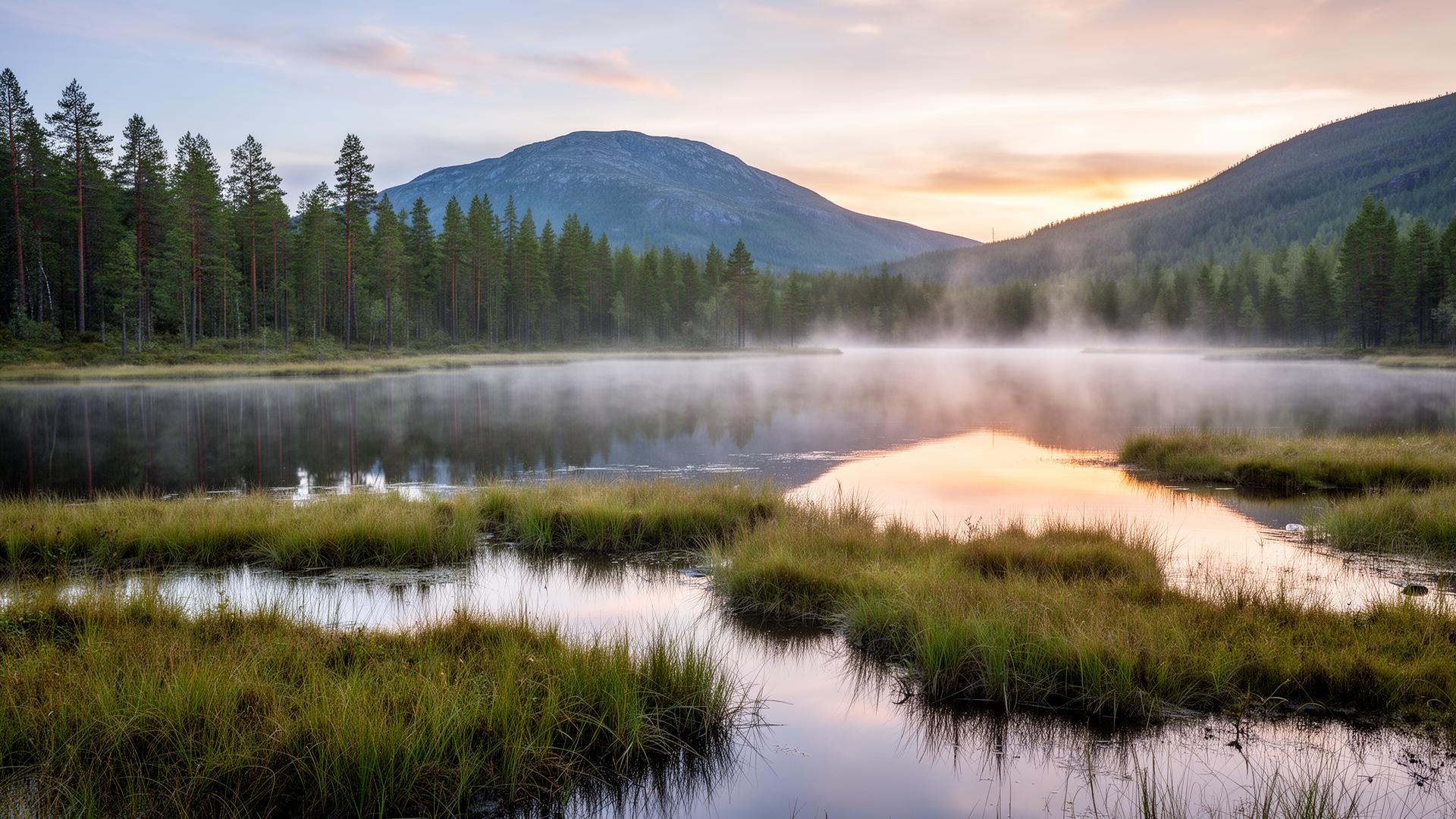
Nordic Lakes & Wetlands
Water is the defining element of the Nordic landscape. Sweden has nearly 100,000 lakes, Finland over 180,000, and Norway's coastline is carved by thousands of fjords and fed by countless rivers. Beyond the lakes themselves, Scandinavia holds some of Europe's most extensive wetlands, peatlands and river systems — freshwater environments that sustain a remarkable diversity of life and play a critical role in regulating the global climate.
A Landscape Shaped by Ice
The extraordinary abundance of lakes in Scandinavia is a direct legacy of the last ice age. As the glaciers retreated roughly 10,000 years ago, they scoured basins in the bedrock, deposited moraines that dammed valleys and left behind a landscape pockmarked with depressions that filled with meltwater. The result is one of the most lake-rich regions on Earth.
Scandinavian lakes range from enormous — Vänern in Sweden is western Europe's largest lake at over 5,600 square kilometres — to tiny unnamed forest pools. Many are oligotrophic, meaning they have low nutrient levels and exceptionally clear water. Others, particularly in the lowlands, are richer in nutrients and support dense plant and animal communities.
The character of a lake is shaped by its geology, altitude and surrounding vegetation. Mountain lakes above the treeline are typically cold, clear and nutrient-poor, with sparse aquatic life. Forest lakes in the boreal zone are often brown-tinged from humic acids leached from peat and forest soils, giving them a distinctive tea-coloured appearance that is characteristic of the Nordic landscape.
Rivers and Waterways
Scandinavia's rivers are among the last wild and unregulated waterways in Europe — though many have also been heavily exploited for hydropower. The great rivers of northern Sweden — Torneälven, Kalixälven, Piteälven and Vindelälven — flow from the mountain range eastward to the Gulf of Bothnia, draining vast catchment areas of boreal forest and mountain terrain.
Several of these rivers remain free-flowing and unregulated, a rarity in modern Europe. Torneälven, which forms the border between Sweden and Finland, is one of the longest unregulated rivers on the continent. These free-flowing rivers are vital for migratory fish species, particularly Atlantic salmon and sea trout, which swim upstream from the sea to spawn in the upper reaches.
In Norway, rivers plunge from the mountain plateaus to the coast through steep valleys, creating some of Europe's most spectacular waterfalls. Many Norwegian rivers have been harnessed for hydropower — Norway generates virtually all its electricity from water — but conservation efforts have protected some rivers as national salmon rivers with restricted development.
Wetlands and Peatlands
Scandinavia's wetlands are among the most extensive and ecologically important in Europe. They include raised bogs, fens, marshes, floodplains and mires — each with its own distinctive plant and animal community. Finland alone has roughly 10 million hectares of peatland, making it one of the most peat-rich countries in the world.
Raised bogs, or mossar in Swedish, are dome-shaped wetlands that receive their water only from rainfall. They are dominated by sphagnum moss, which creates acidic, nutrient-poor conditions that few plants can tolerate. Sundews, which supplement their nutrient intake by trapping insects, are characteristic plants of raised bogs. Cotton grass, bog rosemary and cranberry also thrive in these conditions.
Fens, by contrast, are fed by groundwater and tend to be richer in minerals and nutrients. They support a greater diversity of plant species, including orchids, sedges and brown mosses. Many fens in northern Scandinavia are classified as rich fens — rare and threatened habitats of high conservation value that support specialised plant communities found nowhere else.
Peatlands are of global importance as carbon stores. Northern peatlands contain roughly twice as much carbon as all the world's forests combined. When peatlands are drained for agriculture or forestry, this carbon is released as carbon dioxide. Restoring drained peatlands — rewetting them to halt decomposition — is now recognised as one of the most cost-effective climate mitigation strategies available.
Wildlife of the Freshwater Ecosystems
Nordic lakes and wetlands support a rich and varied community of wildlife. The Eurasian beaver, once hunted to near extinction in Scandinavia, has made a remarkable comeback and is now widespread. Beavers are ecosystem engineers — their dams create ponds and wetlands that benefit fish, amphibians, insects and birds, increasing biodiversity wherever they establish.
Otters inhabit rivers and lakes across much of Scandinavia, feeding on fish, crayfish and amphibians. They are indicators of water quality — thriving where rivers and lakes are clean and undisturbed. Moose are also closely associated with lakes and wetlands, wading into shallow water during summer to feed on aquatic plants and escape biting insects.
The bird life of Nordic wetlands is spectacular. Whooper swans breed on quiet forest lakes and arrive each spring with a trumpeting call that has inspired Scandinavian folklore for centuries. Common cranes gather in vast numbers at staging wetlands during spring and autumn migration — Hornborgasjön in Sweden attracts up to 20,000 cranes each April. Black-throated divers, red-throated divers, goldeneyes, goosanders and a wide variety of wading birds breed across the lake and wetland landscapes.
Fish communities vary with latitude and lake type. Arctic char inhabit cold, deep mountain lakes. Brown trout and pike are widespread. The vendace, a small whitefish, forms the basis of important fisheries in several large northern lakes. Atlantic salmon and sea trout, where they can still access spawning rivers, are among the most culturally and ecologically significant fish species in Scandinavia.
Seasons on the Water
In winter, most Scandinavian lakes freeze. Ice cover typically lasts from November or December through April or May in central Sweden and Finland, and even longer in the north. The ice can grow to a thickness of 50 centimetres or more, and has historically been used for transport, fishing and recreation. Ice fishing remains a popular tradition — holes are drilled through the ice and fish are caught using small jigs or bait.
The spring thaw, or islossningen, is a dramatic annual event. As the ice breaks up, rivers swell with meltwater and flooding can occur in low-lying areas. The open water triggers an explosion of biological activity — plankton blooms, insect hatches and the arrival of migratory birds that have wintered thousands of kilometres to the south.
Summer brings the midnight sun to the northern lakes, and the water is alive with activity around the clock. Loons call through the bright nights. Dragonflies patrol the lake margins. In autumn, the lakes grow still and cold, mist hangs over the water at dawn, and the surrounding forests blaze with colour before the first ice begins to form again.
Threats and Conservation
Despite their apparent abundance, Nordic freshwater ecosystems face significant pressures. Hydropower development has fragmented river systems, blocking fish migration and altering natural flow patterns. In Sweden, roughly 75% of large rivers have been developed for hydropower. Efforts are now underway to restore fish passage through dam removal and the construction of fish ladders, particularly for salmon rivers.
Drainage of wetlands for agriculture and forestry has been extensive, particularly in Finland and southern Sweden. Large areas of peatland have been converted to productive forest or farmland, destroying wetland habitats and releasing stored carbon. Wetland restoration programmes — blocking drainage ditches and allowing water levels to rise — are gaining momentum as both conservation and climate measures.
Eutrophication from agricultural runoff affects some lowland lakes and coastal waters, leading to algal blooms and oxygen depletion. Invasive species, including signal crayfish and certain fish species, threaten native communities in some areas. Climate change is altering ice cover patterns, water temperatures and seasonal cycles, with consequences that are still being studied.
Protecting and restoring Nordic freshwater ecosystems is essential — not only for the wildlife that depends on them, but for the clean water, carbon storage and flood regulation services they provide to millions of people across the region.