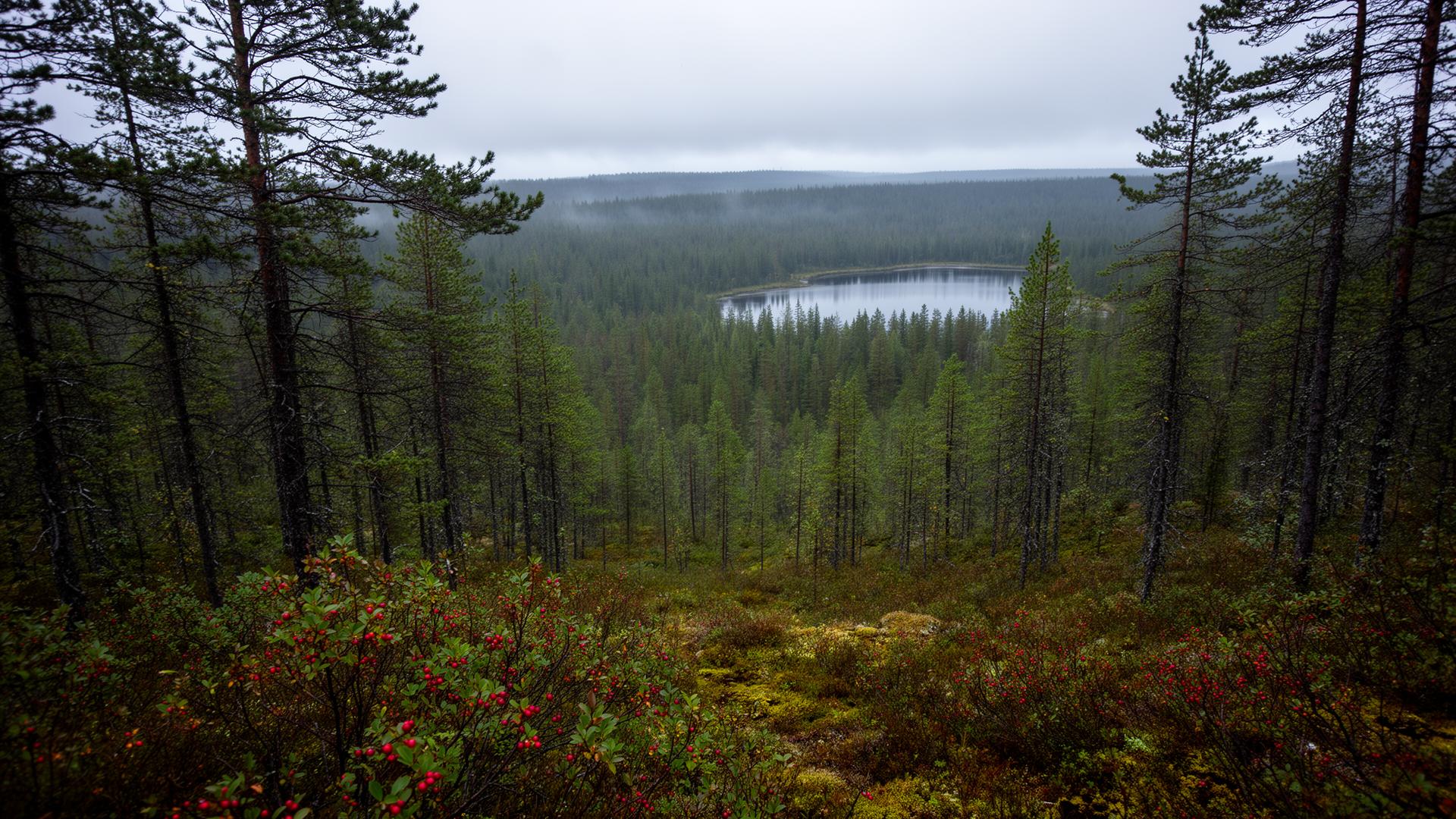
The Boreal Forest — Scandinavia's Taiga
The boreal forest, known in Swedish as barrskogen or taigan, is the largest and most defining landscape of Scandinavia. Stretching across Sweden, Norway and Finland, it forms part of the circumpolar taiga — the world's largest terrestrial biome. Dominated by conifers and shaped by long winters, this ancient forest is home to some of Europe's most iconic wildlife and plays a vital role in the global climate system.
What Defines the Boreal Forest?
The boreal forest is characterised by its dominance of coniferous trees — primarily Norway spruce (Picea abies) and Scots pine (Pinus sylvestris). These two species are remarkably well adapted to the Nordic climate, with needle-like leaves that reduce water loss and conical shapes that shed heavy snow. In wetter areas, spruce tends to dominate, while pine thrives on drier, sandier soils and rocky terrain.
Deciduous trees are also present, particularly birch, aspen and rowan. These species are often found in transitional zones, along watercourses and in areas recovering from fire or logging. The interplay between conifers and deciduous trees creates structural diversity that supports a wide range of plant and animal life.
The Forest Floor
Beneath the canopy, the boreal forest floor is a world of its own. Thick carpets of moss — particularly Hylocomium splendens and Pleurozium schreberi — cover the ground in many areas, creating a soft, spongy layer that retains moisture and provides habitat for invertebrates. Lichens, especially reindeer lichen (Cladonia rangiferina), are abundant in drier pine forests and are a critical food source for reindeer during winter.
Berry-producing shrubs are among the most characteristic plants of the boreal floor. Blueberry (Vaccinium myrtillus), lingonberry (Vaccinium vitis-idaea) and cloudberry (Rubus chamaemorus) grow in abundance. These berries are not only important food sources for bears, birds and small mammals, but have also been harvested by people for centuries and remain a central part of Nordic food culture.
Wildlife of the Taiga
The Scandinavian boreal forest supports a remarkable community of mammals, birds and insects. The moose is the undisputed icon of the taiga — an estimated 300,000 to 400,000 moose inhabit Sweden's forests alone. Brown bears, Eurasian lynx, wolverines and grey wolves also make their home here, though in smaller and more carefully managed populations.
Among birds, the capercaillie and black grouse are emblematic of the boreal forest, performing elaborate courtship displays in spring. Three-toed woodpeckers, Siberian jays, hawk owls and pygmy owls are resident species that depend on old-growth forest with standing dead trees. In summer, the forest comes alive with migratory songbirds that travel from Africa and southern Europe to breed in the long daylight of the Nordic summer.
Insects, though less visible, are ecologically essential. Bark beetles, wood-boring beetles and ants play key roles in decomposition and nutrient cycling. The boreal forest's wetlands are also breeding grounds for vast numbers of mosquitoes and midges — a food source for birds and bats, though a well-known challenge for human visitors.
Seasons of the Boreal Forest
The taiga is a forest of extremes. In winter, temperatures can drop below –30°C in inland areas of northern Sweden and Finland. Snow covers the ground for five to seven months, and daylight shrinks to just a few hours — or disappears entirely above the Arctic Circle during the polar night. The forest is quiet, but not lifeless: moose browse on twigs, lynx hunt hares, and great grey owls listen for voles beneath the snow.
Spring arrives slowly, beginning in late April in the south and not reaching the far north until June. Snowmelt feeds rivers and wetlands, and the first migratory birds return. Summer is brief but intense — with nearly 24 hours of daylight in the north, plant growth is rapid. The forest floor erupts in wildflowers and berries, and insects hatch in enormous numbers.
Autumn brings dramatic colour changes as birch and aspen turn gold and orange against the dark green of the conifers. This period, known as höstfärger, is one of the most visually striking times in the boreal forest. Bears feed intensively to build fat reserves before hibernation, and moose enter the rutting season.
The Role of Fire
Fire has been a natural and essential force in the boreal forest for thousands of years. Lightning-caused fires historically swept through the taiga at irregular intervals, clearing old growth, releasing nutrients into the soil and creating open areas where new vegetation could establish. Many boreal species are adapted to — or even dependent on — fire. Scots pine has thick, fire-resistant bark, and some plants germinate more readily after fire has cleared the ground.
Modern fire suppression has dramatically reduced the frequency of forest fires in Scandinavia. While this protects timber resources and settlements, it has also reduced the structural diversity of the forest. Conservation organisations now use controlled burning as a management tool to restore natural fire dynamics and benefit fire-dependent species.
Old-Growth Forest and Conservation
Only a small fraction of Scandinavia's original old-growth boreal forest remains. Centuries of logging have transformed much of the taiga into managed production forest — typically even-aged monocultures of spruce or pine that are harvested on 60- to 100-year cycles. While these managed forests are productive, they lack the structural complexity of natural old growth: dead wood, varied tree ages, canopy gaps and the rich ground-layer vegetation that many species require.
Old-growth forests are critical habitats for species such as the white-backed woodpecker, which needs large quantities of dead deciduous wood, and numerous lichen and fungal species that grow only on very old trees. Protecting and restoring old-growth boreal forest is one of the most important conservation challenges in the Nordic region.
Sweden and Finland have established national parks and nature reserves to protect representative areas of old-growth taiga. Notable examples include Muddus, Sarek and Store Mosse in Sweden, and Urho Kekkonen and Pallas-Yllästunturi in Finland. However, conservationists argue that current protection levels — covering roughly 5–8% of productive forest land — are insufficient to safeguard the full range of boreal biodiversity.
Climate Change and the Future
The boreal forest is both a victim of and a buffer against climate change. Northern forests store enormous quantities of carbon — in living trees, in soil organic matter and in the peatlands that are interspersed throughout the taiga. When these stores are disturbed by logging, drainage or warming temperatures, carbon is released into the atmosphere, accelerating climate change.
Rising temperatures are already shifting the treeline northward and upward in Scandinavia. Spruce bark beetle outbreaks, fuelled by warmer and drier summers, have caused widespread tree death in parts of Sweden. The growing season is lengthening, which may benefit some species but disrupt the finely tuned seasonal cycles of others. How the boreal forest responds to these changes over the coming decades will have profound consequences — not only for Scandinavia, but for the global climate.